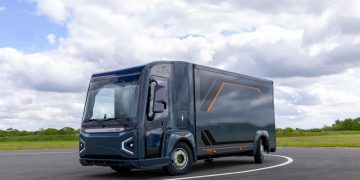
Plus demonstration and evaluation trucks outside of its new headquarters in San Joes, California.
Photo: Jack Roberts
From the moment autonomous trucks burst onto the scene in 2015, some observers assumed that driverless trucks, operating with little or no human control, would be the standard mode of operation when this new technology was fully developed and deployed by fleets.
These were the initial thoughts at autonomous developer Plus. In 2016 and 2017, Plus introduced its Level 4 autonomous control system and gave several demonstration drives to prove the viability of the technology. Today, Plus is actively selling its Level 2 PlusDrive autonomous system to fleets nationwide, including Amazon, which uses PlusDrive on its Class 8 tractors nationwide.
Plus hosted a ride-and-drive for Heavy Duty Trucking at the company’s new headquarters in San Jose, California, in September to not only showcase its autonomous vehicle capabilities, but to also make the case that its system is an ideal introduction to this new technology for fleets and a logical stepping stone toward the more sophisticated control systems that will certain appear in coming years.
The PlusDrive system is classified as a Level 2 autonomous control system — which is striking to consider, given the incredible amount of autonomous control the system has over the vehicle.
Contrary to the impressions many industry observers still have concerning autonomous technology, PlusDrive is really more of an Advanced Driver Safety System. In other words, PlusDrive serves the driver, and does what the driver wants it to do.
“To be sure, we will one day see fully autonomous trucks without humans onboard driving on their own to preset, distant destinations,” says Amit Kumar, Plus’s vice president of engineering. “And that will happen sooner than most people expect. But PlusDrive is a technology that is available today. And one that is focused on safety and fuel efficiency. We are using autonomous technology to assist the driver in new ways that reduces stress and fatigue, boosts situational awareness and delivers a 10% increase in fuel economy.”
PlusDrive is really more of an interactive vehicle control system, as opposed to fully autonomous system. It requires constant driver input and participation to function — and cannot engage at all in certain driving situations — such as freeway on- and off-ramps, for example. When PlusDrive determines that it is entering conditions that it is not cleared to operate it, it prompts the driver to assume full control of the truck. Failing that, PlusDrive immediately slows the truck and brings it to a safe stop until the driver resumes control.
When engaged, PlusDrive aides drivers by maintaining lane integrity and a safe driving speed. The system cannot exceed posted speed limits, but is designed to flow along smoothly with traffic. In heavy congestion or when merging, PlusDrive slows the truck to a safe speed to allow other vehicles to change lanes around it, while keeping the truck rolling at all times (if possible) to prevent the spikes in fuel burn that come when launching a fully-laden Class 8 truck from a dead stop.
But, importantly, the driver remains in full control of the truck and has to “reassure” PlusDrive that they are there and paying attention by either exerting pressure on the steering wheel, or pushing the PlusDrive engagement button on the steering wheel every 15 seconds. If the system does not get confirmation that the driver is actively engaged in driving the truck the system will disengage to prompt a manual resumption of the controls, or, if that doesn’t happen, reengaging and then slowing and stopping the truck.
“The driver is really the Captain of the vehicle,” Kumar stresses. “They are in command. They make all the decisions regarding where the truck goes and how it gets there. PlusDrive simply supports the Captain by helping them safely negotiate traffic and driving conditions.”
Lane changes are an excellent example of how a driver and PlusDrive work together on the road. In heavy traffic, PlusDrive will automatically hold lane the truck is in and adjust to the speed of traffic ahead. But even if the lane the truck is in coming to a dead stop, but the next lane over is open and moving, PlusDrive will not, on its own, change lanes. The driver makes that decision and informs PlusDrive of what they want it to do by activating the turn signal twice, within three seconds, right or left. Once PlusDrive receives that electronic order to change lanes, its lidar, radar and camera systems immediately begin tracking traffic in the desired lane and — once a safe spacing interval opens up — quickly moves into the new lane and once again matches its speed to the flow of traffic.
Simply put, the driver makes all the big decisions concerning the operation of the truck. Any “decisions” PlusDrive makes simply support and assist the driver’s intentions.
The result, according to Amisha Vadalia, senior director of operations for Plus, are drivers that are safer and more alert while driving, and less fatigued when the workday is done.
“My favorite analogy is to think of PlusDrive as a dance partner,” she says. “It works in coordination with a driver and complements and supports the decisions he or she makes in a way that elevates their skills while making them safer. The system never gets tired. It never gets angry. It never gets impatient. And it always gives more information and more control to the driver.”
An Autonomous HOS Extension?
The news is filled with stories today about autonomous test drives, fleet evaluation trials and other demonstrations that suggest that the technology is still largely under development and not yet available for fleets to purchase.
But Plus has been actively selling PlusDrive to fleets for over a year now, beginning in February of 2021.
“PlusDrive is brand/powertrain agnostic,” Kumar says. “And it is really a plug-and-play technology. It can be installed on a truck in about nine hours, and begin work the very next day.”
Plus has a team of installers, and has partnered with Velociti to be a certified system installer nationwide. Plus is also working on certification programs that will allow large fleets to train their own technicians in the installation process and do the work themselves. Once the system is installed, Plus recommends four to five hours of training for drivers to get them used to the system.
And once that is all done, Kumar says PlusDrive requires little to no maintenance outside of replacing sensors in the event of a damage.
“The system self-calibrates and self-diagnoses any problems it encounters,” he explains. “There is no daily maintenance required beyond inspecting cameras and sensors to make sure they aren’t impeded by dirt or road grime. And the system features a modular design. This means that if one component such as an electronic control modular or sensor fails, all a technician has to do is replace it.”
PlusDrive is so effective at reducing driver fatigue, that the company believes that one day, an hours of service extension might be possible for drivers whose ELDs show that they’ve spent the majority of their drive time behind the wheel under autonomous control.
“That would obviously be a huge selling point for us, if drivers could safely log another 100 miles, or so, during a day’s work,” Vadalia notes. “It would be a big incentive for fleets to spec PlusDrive. And we’re in talks with the Federal Motor Carrier Safety Administration and other government agencies about such an extension. But, obviously, lot of data will be required to make a final determination on that. We are already gathering that data — although it will take some time before we have enough on hand to make a case with FMCSA.”